Fun Midterm Election Fact: Richard Bailey Voted for Donald Trump X3

This is the first of a series of November election “fun facts”.

Serving OB, the Peninsula and San Diego Beaches

This is the first of a series of November election “fun facts”.
 By Renee Schmiedeberg / 7SanDiego / Published July 28, 2026
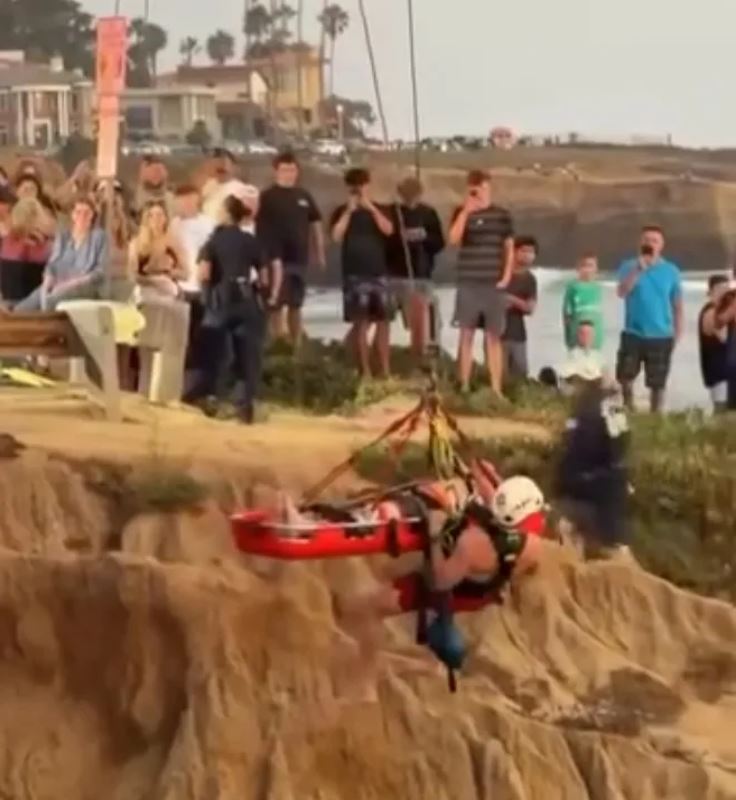
Just two days after a cliff rescue at Sunset Cliffs was captured on video and spread widely online, emergency personnel rescued two more people from the same cliffs during two separate situations on Tuesday, July 28.
During one of Tuesday’s rescues, an individual was seen climbing up the cliffs at Sunset Cliffs before falling off, slamming onto the hard rock below and ricocheting into the ocean. Tuesday’s incident occurred near Sunset Cliffs Boulevard and Froude Street. The extent of that person’s injuries was not immediately clear.
At about the same time Tuesday evening, a short distance away, first responders were busy with a separate cliff rescue, according to the San Diego Fire-Rescue Department.
This one happened near Ladera Street. A man injured his leg and needed to be rescued. First responders were able to locate him and he was airlifted to a hospital.
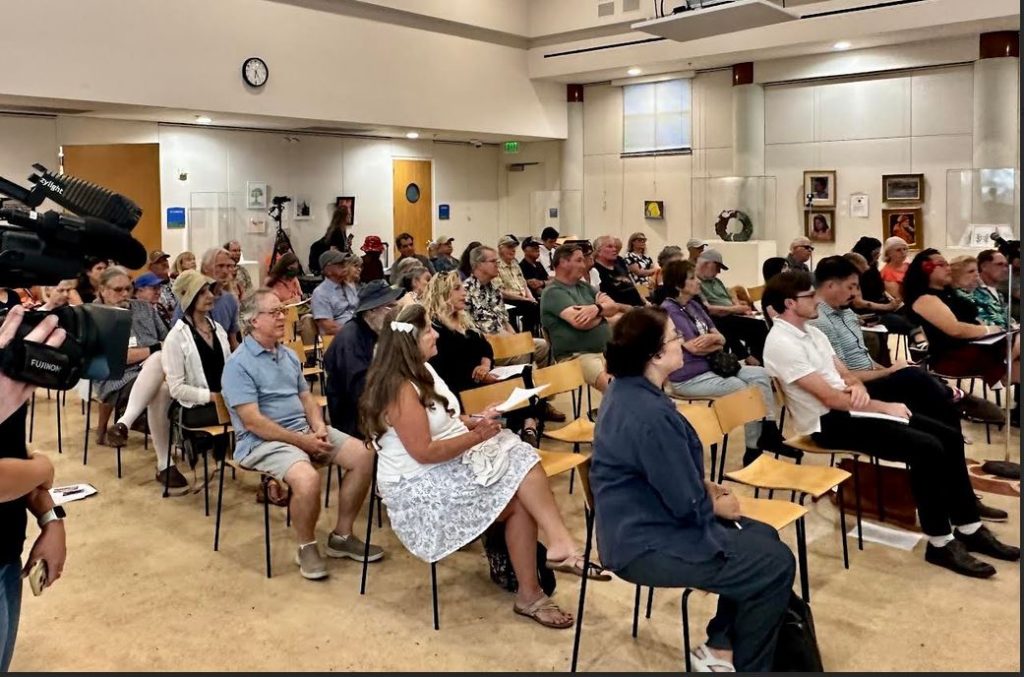 At the height of the “Town Hall” meeting Tuesday night, July 28, at the Point Loma Library, there was standing-room only. I had counted at least 80 people earlier. It had been called by three local planning groups (Peninsula, Uptown and Old Town) and a Point Loma group to air the community’s grievances against the Midway Rising redevelopment project of the sports arena area, NAVWAR — the Navy’s redevelopment of sections of Old Town, and Senate Bill 958, that if enacted, would pour grease on the skids for Midway Rising’s plans.
Eric Law — chair of the Peninsula Community Planning Board — opened the gathering. He later set the tone when he told the crowd, and the two TV stations present:
“Everyone that has anything to do with housing or businesses here on the peninsula wants to see Midway redeveloped. They just dispute that you need to build it over 30 feet.”
Other presenters included Scott Case and Patty Ducey-Brooks of the Uptown Planners Community Planning Group, Ralph Teyssier, a community activist and engineer, and Eric Law. Other locals sat at the front table ready to answer questions, including Christine Smith of Neighbors for a Better San Diego, and Don Severns, formerly a veteran Peninsula planner.
Case spoke on SB 958 and CEQA, the California Environmental Quality Act. In brief, CEQA, passed in 1976, requires public agencies to evaluate and mitigate the environmental impacts of proposed projects across the state. It has played a crucial role over the decades in protecting California’s environment, including air, water quality, wildlife habitats, historic sites and public health. Basically, it ensures projects consider environmental consequences before being approved, and requires public review and oversight. Unfortunately, many exemptions have been created and now CEQA resembles swiss cheese.
SB 958 seeks to remove elements of CEQA, Case said. It will set a precedent for limitations to be created to CEQA. It applies to other projects across the state.
 by Dorian Hargrove / Times of San Diego / July 27, 2026
The owner and developer of a massive proposed ADU project in Pacific Beach, known as Chalcifica, has released new plans for the two parcels, plans the developer hopes residents will embrace.
The new proposal comes as Chlacifica’s owner — Infill Innovation, formerly SDRE — is stuck in a legal battle with a resident group over the company’s old plans to build a 136-unit ADU project on two parcels located at Pacifica Drive and Chalcedony Street in PB.
“Our goal is to move forward with a project that adds much-needed attainable housing units in Pacific Beach while addressing concerns so everyone can benefit,” Infill Innovation CEO Brian Doyle told Times of San Diego.
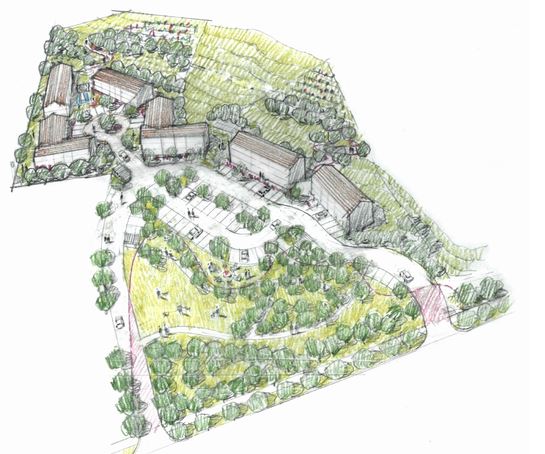
Doyle shared the latest renderings of the proposed multi-ADU project.
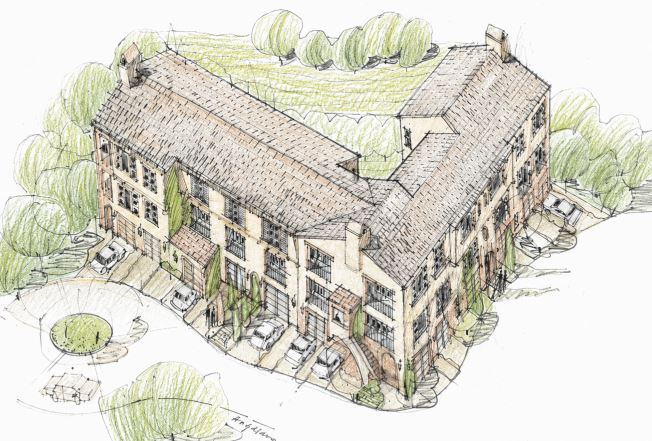 The new proposal reconfigures the site, moving the buildings and parking away from what may be culturally sensitive lands and redesigning the large block-like apartment-style buildings into six buildings with 125 total units.
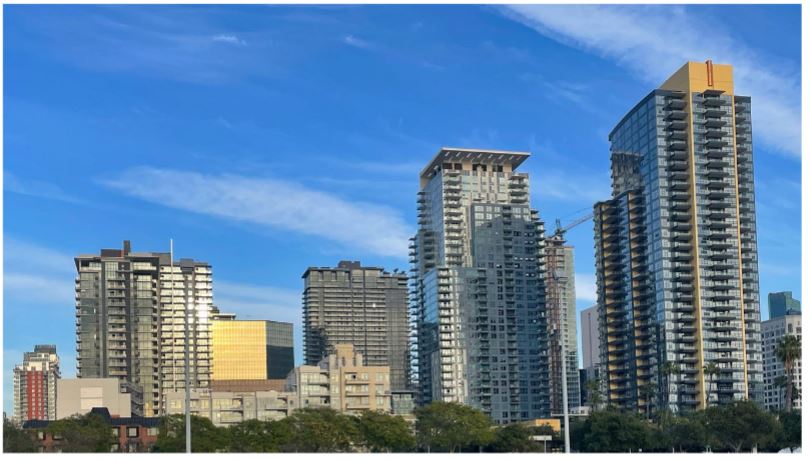 How to Make Changes in the Underfunded Finest City
By Paul Coogan
California is the land of gold rush mentality. After the yellow stuff was scooped up, agriculture, hospitality/entertainment, and tech put gold in the coffers.
Now, the boondoggle is real estate, a limited resource and increasingly in demand. Escalating land value triggered a property tax revolt in 1978 (Prop 13) and now we live in the post-capitalist, libertarian result of a society that wants everything but refuses to pay for anything.
The recent trash fee battle in San Diego is a microcosm of this attitude. It started when in 1919, the public voted in favor of the People’s Ordinance to have free waste removal after the city started making money on selling the haul to pig farmers. Thus the metropolis was left scraping the pot to fund the dump year after year. Folks complain about busted bins, but liberals and conservatives alike were willing to join hands and trash city hall for trying to make ends meet.
A change in leadership at City Hall will only be shuffling deck chairs on the Titanic, as the layers of bad policies and worse state laws have created a Gordian knot that strangles new ideas in their infancy.
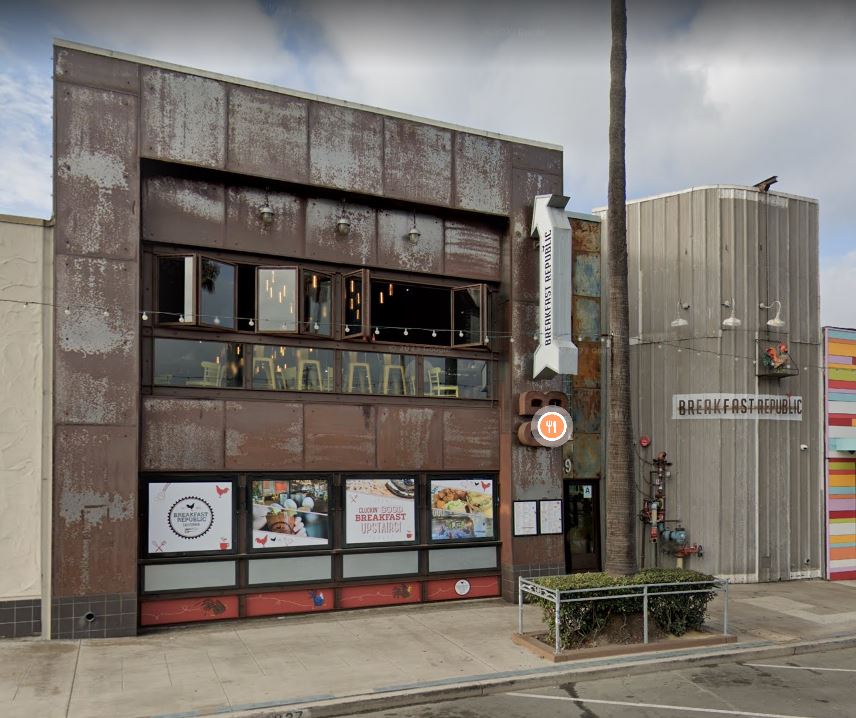 According to Lori Weisberg at the San Diego U-T, OB’s Breakfast Republic on Newport Avenue is set to close August 9th.
It and along with the company’s North Park and Encinitas locations will all serve their last meals that day.
Even if you will miss these popular eateries, don’t shed a tear for the San Diego hospitality company that founded Breakfast Republic more than a decade ago. Even though three older locations aren’t doing well, the company plans on opening a dozen new restaurants in Texas over the next five years.
The Ocean Beach venue is just not performing as well as the eight other Southern California locations that are. Weisberg:
The Ocean beach restaurant, at 5,000 square feet, is far larger than the locations [founder Johan Engman] is now opening, and it’s also on the second floor, which isn’t as convenient for customers.
Business declined at the North Park restaurant partly due to “the removal of 175 street parking spaces to make way for bike lanes several years ago.”
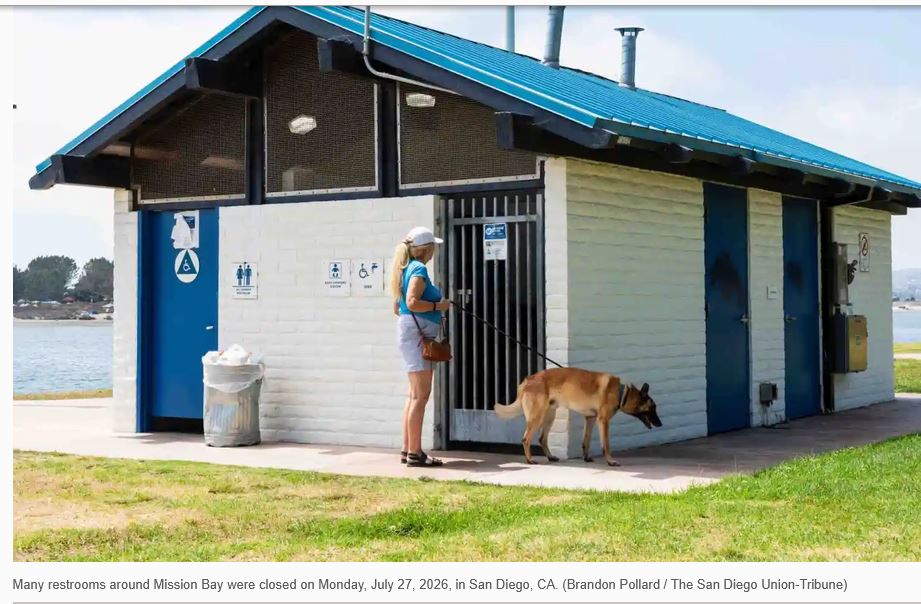 San Diego City Councilmember Raul Campillo says he has found a pot of money the city can use to re-open more than a dozen Mission Bay restrooms closed in early July as part of budget cutting. He wants the city to use “the $1.8 million in budgeted election costs that were freed up last month when a possible November ballot measure got postponed,” as the U-T reported yesterday.
The freed-up money became available last month when the council’s Rules Committee delayed indefinitely — but at least until 2028 — a ballot measure proposed by Councilmember Kent Lee to shrink the mayor’s power, reports the U-T.
By closing 13 of the 28 restrooms that serve tourists and locals alike at Mission Bay Park, the city is saving a whopping $546,000 in maintenance and cleaning costs.
Campillo says the closures are creating a public health hazard because park visitors have begun relieving themselves in grassy areas and other locations. In a July 15th memo to the mayor, Campillo wrote,
“Redirecting those funds would address an immediate community need and help restore a basic public service that is essential to the safe and enjoyable use of Mission Bay Park. Our constituents have asked for it.”
Yet Mayor Gloria rejects Campillo’s proposal. He claimed he shares the councilmember’s concerns, but says it would be financially risky to reopen the restrooms using the newly available money.
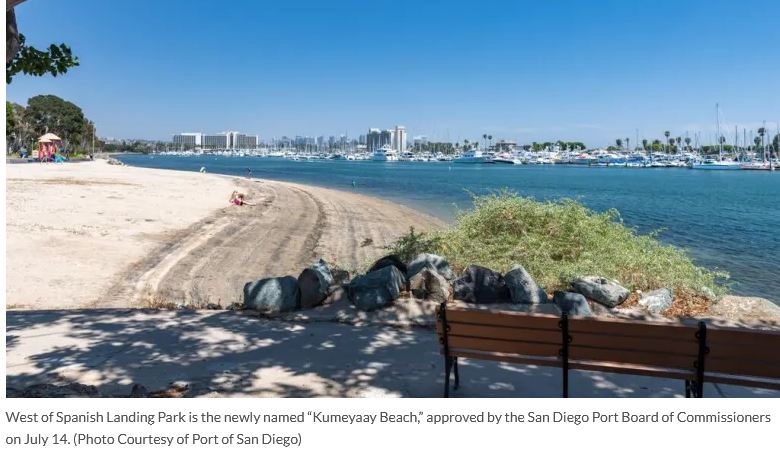 The Port of San Diego has officially named a beach at Spanish Landing “Kumeyaay Beach,” acknowledging and responding to years of efforts by local Kumeyaay tribespeople to do such.
At a July 14th meeting of San Diego Port’s Board of Commissioners, the beach’s renaming was approved.
Before the vote on the renaming, Jessie Pinto, an elder of the Kumeyaay Nation, spoke:
“The name, ‘Kumeyaay Beach,’ is more than a sign. This is an opportunity to acknowledge the first people of the land, to tell a more complete story of San Diego. The visitors who see this may ask, ‘Who are the Kumeyaays?’ The simple question opens the door to education, understanding and respect.”
Members of the Kumeyaay Nation have long advocated for giving this beach a name, due to its cultural significance.
 By Mark Powell / Times of San Diego / July27, 2026
For years, many of us have been saying the same thing: San Diego is not a bike-friendly city. In five or ten years, I believe many of today’s decision-makers will look back and realize the concerns raised by residents and business owners were not resistance to change; they were grounded in reality.
Unlike many European cities, San Diego was designed around the automobile. European cities evolved over hundreds of years, often between 500 and 1,000 years ago, with compact neighborhoods, narrow streets, and destinations within walking or biking distance. San Diego developed very differently.
Our communities are spread out, our roads are wider, our destinations are farther apart, and our terrain includes countless steep hills. For many people, riding a bicycle is simply not a practical way to get to work, school or run errands.
Supporters of expanded bike lanes often point to ambitious goals for increasing bicycle commuting. There’s nothing wrong with encouraging cycling, but public policy should reflect how people actually choose to travel. Most San Diegans rely on their cars because they need to.
Families juggle work, school, sports, shopping and appointments that often require driving across several neighborhoods in a single day. That reality is unlikely to change simply because more bike lanes are painted on our streets.
 By Marc Elias / Democracy Docket / July 27, 2026
Election Day is less than 100 days away.
Donald Trump is deeply unpopular. The Republican Party has little to show for its time in power. Prices are up, and the economy is stagnant. We are at war in the Middle East.
The GOP is not acting like a party trying to persuade voters to support its candidates — because it isn’t. Instead, the Republican Party’s entire strategy boils down to this:
Four AP Reporters / July 26, 2026
What’s for dinner? Lately, at Apral Jack’s house, it’s whatever is on sale.
Jack, 50, scouts an app for deals at her local supermarket before she buys groceries. When she reaches the store, she looks in the weekly circular for coupons she might have missed. If shelf prices look too high, she tries to find lower prices someplace else.
“The apples went up here, the ones I eat, so now I’m not going to get them here,” Jack said as she pushed a cart into a Stop & Shop near her home in Lexington, Massachusetts.
Couponing, comparison shopping and cutting back on favorite foods are new habits for her and millions of other Americans as they absorb the biggest jump in grocery prices in a half-century. Buying food to eat at home has gotten 33% more expensive since the beginning of 2019, according to government figures.
With a conflict in the Middle East creating more price pressures, the cost of filling refrigerators, freezers and pantries has made affordability a central issue in the fall midterm elections.
 by Debbie L. Sklar / Times of San Diego / July 22, 2026
Before there was Del Mar, there was another racetrack.
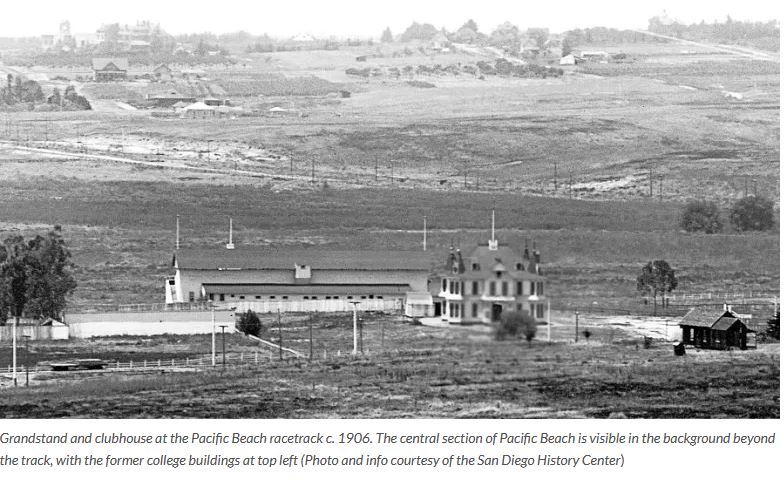
There’s no sign of it today, but Pacific Beach once had a racetrack — and for a brief period in the 1880s, it became one of the region’s most notable gathering places.
Today, Pacific Beach is known for its boardwalk, beach traffic, and nightlife. In the late 19th century, however, it was part of a developing coastal landscape shaped by real estate speculation, rail expansion, and ambitious efforts to create destination communities.
One of the most ambitious of those early projects was the Pacific Beach Driving Park, also known as the American Driving Park, a horse racing facility established during San Diego’s 1880s land boom.
The track was developed in 1887 after the Southern California Breeders’ Association acquired property for a formal racing venue. Located on what was then undeveloped land near Pacific Beach, the site included a racetrack, stables, and a grandstand designed to support organized races and public events while also helping promote surrounding land sales.
Say Keep it goin' to the OB Rag
with your donation today!







Copyright © 2026 OB Rag
Recent Comments