

Category: Culture

Two Candidate Forums for District 2 City Council Set — First Is on Thursday, March 5 in Clairemont
 The League of Women Voters San Diego have just announced that they have set up two candidate forums for City Council District 2 this spring.
The first is scheduled for Thursday, March 5 – 5:30-7:30 PM at the Cathy Hopper Clairemont Friendship Center, located at 4425 Bannock Ave, San Diego 92117 This Forum is hosted by the Clairemont Town Council and the League of Women Voters, SD
Homelessness in Ocean Beach: Facts, Friction, and the Path Forward
 By Jillian Butler
Within the Peninsula Community and San Diego as a whole, homelessness continues to be a pervasive topic brought up in social media discourse, political campaigns, and community meetings.
It is equally divisive as it is pervasive. Some argue for strict crackdowns while others worry about over-policing. Regardless of individual feelings, the homelessness crisis of San Diego is a problem that requires concrete solutions. Ocean Beach has always prided itself on compassion. But compassion alone hasn’t resolved the growing tension around homelessness in 92107.
The San Diego Regional Homeless Task Force estimated that there were no less than 9,905 homeless residing within San Diego County in 2025. At least 221 of those individuals are in the 92107 area code. The average age of those experiencing homelessness is 43 years old. The gender demographics are closely split with 51% being female and 49% being male. Racially, Black people of color make up 48% of the homeless population. Both senior (age 55+) and youth (age 12-24) homeless rates are consistently increasing.
Why Ocean Beach Needs to Turn Out at City Hall on Tuesday, Feb. 24
 OB’s Historical District Needs to Be Protected
As it stands now, on Tuesday, the 24th of February in the afternoon, the San Diego City Council will get to decide on a good deal of the future of Ocean Beach.
There is an animal out there ready to devour our sedate coastal village and it’s called “Preservation and Progress Package A.” It’s a set of policy proposals affecting how the city preserves and designates historical properties — or neighborhoods. These “reforms” specifically call out the historic district that Ocean Beach enjoys, called the “Ocean Beach Cottage Emerging Historical District”.
Why? What’s going on?
OBceans aware of the neighborhood know there’s many small cottages scattered throughout the blocks that make up Ocean Beach, but may not be aware that these old cottages add besides the obvious an historic character to the community — plus add certain protections.
The original application for an Ocean Beach historical district designation was filed with the state Department of Parks and Recreation on June 2, 1999, by the now-late OB Planning Board member Priscilla McCoy.
The district is termed “emerging” because there never has been a complete survey of all the buildings that potentially qualify to be historic. Usually a full historic district designation protects surrounding buildings, even ones not considered historic, in order to preserve community character. And lately, the city has been arguing that OB’s historical designation applies only to the 72 cottages, built between 1887 and 1931. And nothing else. Yet, several local OB historians estimate the total number of potentially historic cottages at more than 300.
The San Diego ‘3 Amigos’: Republicans Who Now Head Up San Diego Conservative Groups
 By Arturo Castañares / La Prensa / Feb. 18, 2026
Three former Republican elected city leaders now head up three of the area’s top civic groups, even as Democrats hold every elected position in the City of San Diego.
This week, former San Diego City Councilman Mark Kersey was announced as the new CEO of the San Diego County Taxpayers’ Association, while former Councilman Chris Cate leads the San Diego Regional Chamber of Commerce, and former San Diego City Councilman and Mayor Kevin Faulconer leads the San Diego Lincoln Club business league.
The three men served in office concurrently from 2014 to 2020.
Kersey, who served two terms on the City Council from 2012 to 2020, took over the local taxpayer advocacy group after its former leader, Haney Hong, resigned last March. The organization monitors government agencies and awards its annual Golden Fleece Award for the worst use of taxpayer dollars, as well as its Media Watchdog Award for news coverage of local agencies.
The Words Nobody Heard at the Planning Commission Hearing on Proposed ‘Preservation’ Policies: ‘The Consistency Analysis Is Not Accurate’
 By South OB Girl
It is unfortunate for San Diegans that many wise words have fallen on deaf ears during the proceedings of the city’s “Preservation and Progress Package A,” which proposes amendments to existing policies for historic properties, historic communities, historic designation, de novo appeal, and San Diego’s historical resources. As Save Our Heritage Organisation (SOHO) described in their January 9, 2026 OB Rag article:
This fast-tracked proposal would weaken San Diego’s historic preservation program by allowing the City Council to override expert historic designations, thereby stripping protections from historic districts… while prioritizing new construction over true preservation.
Package A specifically targets Ocean Beach for the construction of high-density Complete Communities Housing Solutions and specifies Ocean Beach for the removal of historic protections. This would pave the way for high-density housing developments with greatly reduced setback requirements and little to no on-site parking. Such construction is currently not allowed in OB.
Package A paves the way to annihilate the small beach town as we know it while flooding our community with big box apartment buildings that could be mixed in with single family homes and historic beach cottages. Such development would have a myriad of repercussions including oversaturation of on street parking due to limited on-site parking and a strain on public utilities such as water, sewer, and power.
Rules Committee Blocks Campillo Plan for Fee Ballot Measure Studies
 By Kate Callen
In rej ecting proposals for deeper fiscal analysis of city-driven fee ballot measures, three San Diego City Councilmembers decided February 18 that preserving a broken status quo is more important than restoring public faith in city governance.
Councilmember Raul Campillo’s efforts to keep voters better informed through cost-of-service studies were brusquely dismissed by his colleagues on the Rules Committee. Joe La Cava and Vivian Moreno took umbrage that Campillo would even suggest such a thing. Kent Lee worried that greater transparency about a ballot initiative would create “a multitude of hurdles” for raising existing fees or creating new ones.
A fourth committee member, Sean Elo-Rivera, participated remotely and did not speak.
Campillo’s proposals were driven by public outrage over the notorious 2022 “bait and switch” trash fee Measure B. Voters approved the initiative after the Independent Budget Analyst (IBA) estimated that monthly fees would run $23 to $29. When the measure passed, the city announced that — oops! — the actual monthly fees would approach $50.
Becoming Inspired by San Diego’s Original ‘Master Architect’, Irving Gill, in Resisting Most Aggressive Dismantling of Our Preservation Protections
 What would Irving Gill Say to City Hall Today?
By Alana Coons and James B. Guthrie, AIA
In the early years of the 20th century, San Diego was young and full of hope. In 1893, among the dust and ambition, walked Irving J. Gill, an architect by profession but a visionary to his core. He said: San Diego “has an opportunity unparalleled in the history of the world, for it is the newest white page turned for registration.”

As a master architect, he recognized what was special about San Diego and designed buildings that responded to those special characteristics. In the process he constructed a unique “sense of place” for his clients and, through his designs’ beauty and durability, for us and those that will follow.
San Diego has long respected Gill’s contribution to our community, not as relics of past times, but as an ongoing legacy and a part of who we still are.
Preserving the Public’s Role in City Council Decisions
 By Geoff Hueter
The City of San Diego is changing Council Rules to comply with a new state law that requires “equal treatment” for in-person public comment and residents who attend meetings virtually and phone in their comments.
Among the options beings considered by our city is the elimination of group presentations and time ceding. This change would limit citizens to a one to three minute comment, depending on the number of people who wish to speak on an issue.
The loss of group presentations and time ceding would severely limit the ability of Neighbors For A Better San Diego and other organizations to present a comprehensive, factual analysis of new regulations being considered by the City Council.
The California Bear Will Be Target in Next ICE Surge
 By many indications, it appears that California will be one of the targets of the next “ICE surge.” Even though there won’t be any surge during this current government shutdown, ICE still is currently expanding its physical presence across the country. Its parent, the Department of Homeland Security (DHS) is carrying out a hush-hush campaign to open up 250 facilities and offices in nearly every state, and the Golden State — long a demises for Trump — is at the top of the list.
Check out the following coming down in California:
• Irvine: New offices at 2020 Main Street, located directly adjacent to a childcare agency.
• Los Angeles: General expansion of existing federal office spaces.
• Sacramento: Security upgrades and expansion at the John E. Moss building, which houses a DOJ immigration court.
• San Diego: Growth at the Edward J. Schwartz Courthouse and federal building.
• Santa Ana: Expansion at the Santa Ana federal building, situated blocks from a church and a major high school football stadium.
• Van Nuys (Los Angeles): Expansion at the James C. Corman federal building.
This secret federal government campaign to purchase warehouses for the massive expansion of ICE is now known due to documents posted online late last week by Republican New Hampshire Gov. Kelly Ayotte. Also, a federal official said that California — and New York are among the “next” for a surge similar to the campaign in Minneapolis. These plans include embedding hundreds of new ICE offices in Sacramento, Irvine, Santa Ana and Van Nuys, according to an explosive report by WIRED magazine.
Donna Frye: ‘Making Sense of How the City Council Is Attempting to Increase and Also Decrease the Public’s Participation in Meetings’
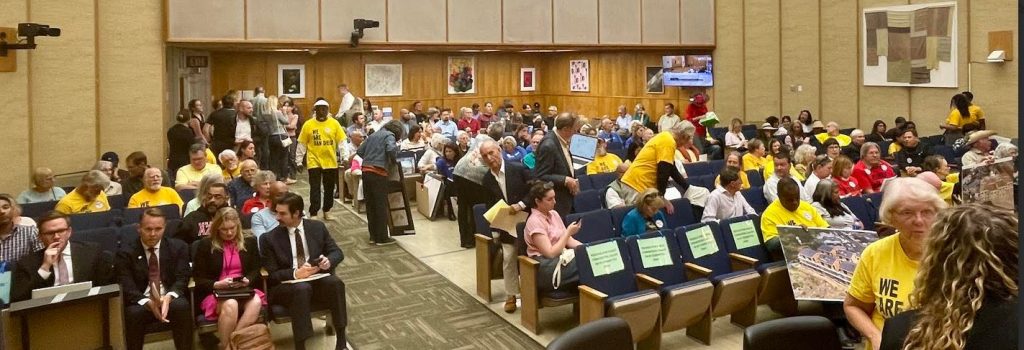 By Donna Frye
The Community Coalition Bulletin for this week included helpful and important information about the February 18, Rules Committee meeting regarding the public’s right to know and some important state Brown Act amendments.
Items 2 and 3
As discussed in the Bulletin, Items 2 and 3 are being proposed by Councilmember Campillo. The changes are a result of the fees San Diego residents were led to believe they would be paying when they voted to support a trash tax. As everyone knows, voters were told in the ballot materials that the fees would be much lower than the amount approved by council. It’s why Campillo voted against the increased fees.
His proposal includes an option for the council to require that ballot measures have a cost-of-service study done before, not after, voters cast their ballot to avoid another trash fee debacle. “It would only apply to ballot proposals put forward by Councilmembers, the Mayor, mayoral departments, independent department directors, or a public agency” but “would not apply to proposals submitted by members of the public.”
Ghosts of Point Loma: Shipwrecks, Smugglers, and Sea Legends
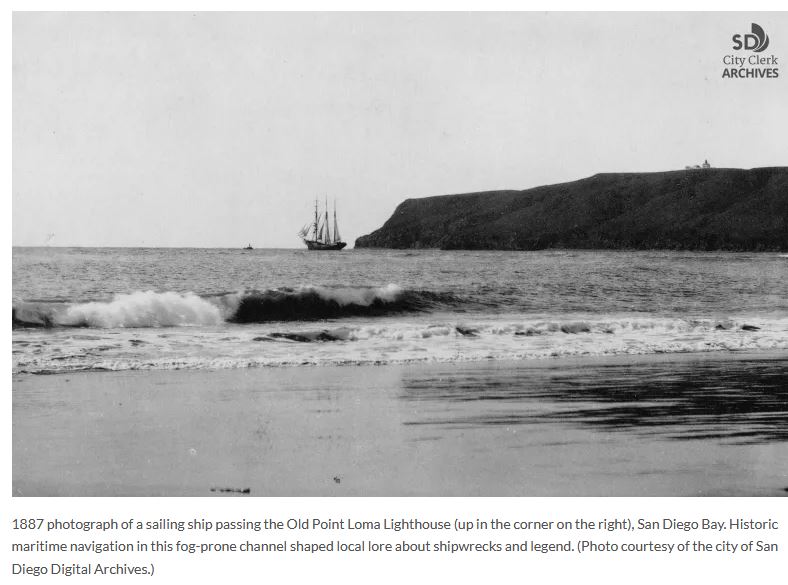 by Debbie L. Sklar / Times of San Diego / Feb. 13, 2026
For centuries, the waters off Point Loma have been both a gateway and a hazard. Guarding the entrance to San Diego Bay, the peninsula’s rocky shoreline, strong currents, and frequent fog made it one of Southern California’s most treacherous stretches of coast. Long before visitors hiked the bluffs, ships ran aground, illicit cargo moved ashore, and maritime stories took root — shaping local lore that still echoes today.
Navigation into the bay was especially tricky in the 19th century. Fog often concealed the narrow channel, and early nautical charts were incomplete. The Old Point Loma Lighthouse, first lit in 1855, was intended to guide ships safely to harbor. Instead, its high perch often placed the light above the fog, making it invisible to sailors below. Mariners complained, and shipping records indicate that vessels continued to run aground. In 1891, the lighthouse was abandoned and replaced by a new light positioned closer to the water.
Shipwrecks along the Point Loma coast were not uncommon. Many vessels were damaged rather than destroyed, but contemporary newspaper accounts describe ships stranded on shoals, cargo lost overboard, and crews rescued under dangerous conditions. These incidents reinforced the area’s reputation as a hazardous passage — a reputation that lingered even as navigation tools and harbor improvements advanced.







Recent Comments